Average Reviews:

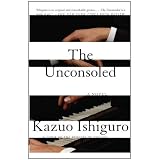
(More customer reviews)THE UNCONSOLED is the most frustrating book I've ever read. It's also one of the most rewarding. It wasn't until I reached the end that I began to understand it, and I would never have reached the end at all if I hadn't listened to the audio version. David Case delivers an excellent narration, his calm, dry approach highlighting the emotions in each situation and his analytical, english accent well suited to the book's formal, elaborate tone.
Mr. Ryder, a world renowned pianist, has just arrived in an unidentified city for reasons he can no longer remember, except it seems he has some moral duty to help the city's occupants and he is to give a concert and speech on the coming Thursday night. Since Case uses a slightly Germanic accent for the city's people, one can assume the unnamed city is in Germany. The city is apparently a cultural and musical center that has fallen on hard times after idolizing the wrong musician and now has its hope of redemption pinned on another, ailing musician, Mr. Leo Brodsky. The entire city is coddling Brodsky along in the hopes he will manage a spectacular performance on this important Thursday night.
Every character Ryder encounters greets him most obsequiously while begging of him some small favor -- critiquing a piano piece, visiting a particular restaurant, studying some albums -- until he (and the reader) is overcome with exhaustion. Yet Ryder always feels the need to listen to these longwinded concerns and to try to offer some help, for he has both the sense of having been brought here to make things right and of his own overblown self importance. Although he feels a stranger to these people, it becomes obvious he isn't -- he has been to this city before and has a life with a woman, Sophie, and her small boy, Boris.
Ryder isn't suffering from amnesia exactly. Sometimes he can remember things. Sometimes he can't. Sometimes his memories change. Often they are distorted, such as when he believes his motel room is actually his old bedroom or an old abandoned car he finds is actually his family's vehicle from his childhood. At other times memories will come back to him in the strangest ways, for occurances he did not personally witness.
Time is badly warped -- thirty minute discussions take place during ten minute trips -- and all the while there is a terrible sense of urgency, of always being too late or in the wrong place or unable to get from here to there. Often Ryder finds himself back where he started, even though he traveled a long way from point A to B. Doors in dinner halls open back into his hotel; during a lunch date he discovers he's in the same cafe where he ate breakfast. Farms and forests and grassy hills with huts appear in the middle of the city. Once a brick wall blocks his path, built right across the road for no apparent reason. At one point Ryder wears a dressing robe to an evening party, yet no one notices (even when it falls open). The people are too involved in a discussion concerning Mr. Brodsky's dead dog.
As the sense of rush and desperation increased, I got the feeling the whole book was a maze from which Ryder (and, incidentally I) could not escape. It reads like one of those nightmares where you're moving in slow motion, unable to stop the events around you, unable to speak, powerless to reach your destination. And, as in those nightmares, people from the past keep cropping up where they have no reason to be. Ryder's old schoolmates, his childhood girlfriend, they show up with their own curious demands. In fact, everyone Ryder meets becomes more and more demanding of him, while seemingly unaware of it. Their moods shift rapidly (so do Ryder's), and while they view Ryder as a god-like figure, they also seem to secretly despise him and be laughing at him, as when he is in the company of a journalist and photographer and the two shout over his head to each other about how vain and conceited he is. Incidentally, Ryder hears everything they say, then proceeds to do exactly what they have just predicted he would. As the book progressed I grew to dislike Ryder intensely, especially for his willingness to give other people advice that he could not follow himself and for his totally callous treatment of Boris.
By the end of the book it seemed to me that certain people -- Boris; the hotel manager's twenty-some-year-old son, Stephan; and Mr. Brodsky -- represent Ryder himself at different periods in his life (this somewhat explains the unreliable narration). Boris is struggling to attract his father's attention, Stephan is struggling with parents who refuse to recognize his musical gifts, Brodsky has reached the end of his career, a shell of former glory. The entire story seems to be a dreamlike life journey, a fusion of past and future events into one surreal present. I found the ending incredibly sad; I was touched by the way Ishiguro highlights the futility of life, the farce lying beneath every society, the way people do not want to change.
Rating THE UNCONSOLED is difficult. If I judge it by how boring and frustrating certain portions were, it gets two stars. But if I judge it by what Ishiguro ultimately accomplished, it gets five stars. Because the ending brought it all together for me, I have settled on the latter, a hopefully fair rating for a book I will never read again, but one I will certainly never forget.
Click Here to see more reviews about: The Unconsoled
 Get 32% OFF

0 comments:
Post a Comment