Average Reviews:

(More customer reviews)I have read many novels by many writers, both American and foreign, but it's been a good long while since I've read something so penetrating and perceptive as Carson McCuller's first and last novels. The characters in the books, their lives and personalities, are so well thought-out and delineated that you have to wonder how a woman of 23 could put something like this together. Anyway, below is a synopsis of each story in this volume.
The Heart is a Lonely Hunter is the longest of Carson McCullers' novels, and the first. She wrote it in the late `30s, and published it in 1940, when she was 23. It's an incredible first novel, and amazingly prescient and wise for someone of her age, era, and upbringing. The story revolves around a deaf mute, John Singer, who works engraving silverware in a small city in the South somewhere. He has only one friend in the world, another deaf mute who works for his cousin, making candy. As the story begins the candymaker (named Antanopolous) is committed to an asylum, and Singer moves from the home they shared, and slowly begins to acquire a circle of other friends. Principle in this circle are four people: Mick, the daughter of his landlords at the rooming house he lives in; Biff, who runs the diner where he takes his meals; Blount, another denizen of the diner, who wishes to unionize the local mill-workers; and Dr.Copeland, a black man who rages against the injustice of white society towards him and his race. The heart of the story is a character study of these five people, with alternating chapters following the one and then the other. Each is intelligent, in his or her own way, and each has special insights into the world around them. How these characters interact, and the relationships between them and the rest of the world, make the heart of the story and most of the book.
Reflections in a Golden Eye is a shorter story, one of McCullers' novels that is really more of a novella. The plot revolves around a love triangle that develops between two officers on an Army base, and the wife of one of them. There's also a strange, solitary, enigmatic private who tends the horses on the base, and he interacts with the other characters. Frankly, I didn't enjoy this story as much as The Heart is a Lonely Hunter. The characters weren't anywhere near as believable, and their motivations weren't as transparent or understandable. The ending was also somewhat predictable.
The Ballad of the Sad Café is the shortest of McCullers' novels or novellas, weighing in at 60 pages. It's the story of a strange, unpredictable relationship between the standoffish businesswoman who dominates the culture of a small town, and a dwarf hunchback who shows up one day claiming to be her long-lost nephew. How the two of them interact in the story is strange, to say the least, and not wholly explained in the story. This creates an enigmatic atmosphere, and as the story progresses and it becomes obvious we're not going to receive an explanation of things, you find yourself re-reading passages looking for clues as to motivations. I enjoyed this story much more than Reflections in a Golden Eye, perhaps almost as much as The Heart is a Lonely Hunter.
The Member of the Wedding is perhaps McCullers' most strange work. The heart of the book is built around the fantastic intentions and beliefs of a twelve-year-old girl. In the first portion of the book, she's known as Frankie. Later, when she gets the idea she's going to leave with her older brother on his honeymoon, she changes her name to F. Jasmine, and the book follows that convention. Once it develops that she can't go with the brother and his new bride (you knew this was going to happen) she becomes Frances. There isn't much of a plot other than this girl fantasizing about all of the things she's going to be or do, and looking down her nose at all the common people who surround her, who she thinks are beneath her.
Clock Without Hands is the best of McCullers' books other than The Heart is a Lonely Hunter. I now wonder if the length of the books had something to do with whether I liked them or not. She seems to have been able, in the longer books, to build her characters more, and have more plot twists. Clock Without Hands is about a dying pharmacist in a small Georgia town, and the events surrounding his death, but it really turns out to be more about one of his acquaintances, a senile old judge who imagines himself a great leader of the opposition to the desegregation movement. The episodes of the Civil Rights movement, as McCullers recreates them, become at times farcical and silly, and the resistance to the movement altogether silly and irrational.
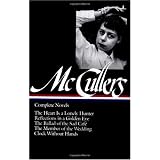
Library of America volumes are wonderful to hold and read, and this is no exception. The type is clear, the book handy to hold or slip into a pocket. Given McCullers' stature as a writer, I think I'm going to value this book for a good long while.
Click Here to see more reviews about: Complete Novels: The Heart is a Lonely Hunter/Reflections in a Golden Eye/The Ballad of the Sad Cafe/The Member of the Wedding/The Clock Without Hands (Library of America)
When The Heart Is a Lonely Hunter was published in 1940, Carson McCullers was instantly recognized as one of the most promising writers of her generation. The novels that followed established her as a master of Southern Gothic."McCullers' gift," writes Joyce Carol Oates, "was to evoke, through an accumulation of images and musically repeated phrases, the singularity of experience, not to pass judgment on it." McCullers effortlessly conveyed the raw anguish of her characters and the weird beauty of their perceptions. Set in small Georgia towns that are at once precisely observed and mythically resonant, McCullers' novels explore the strange, sometimes grotesque inner lives of characters who are often marginal and misunderstood. Above all, McCullers possessed an unmatched ability to capture the bewilderment and fragile wonder of adolescence. In The Heart Is a Lonely Hunter, an enigmatic deaf-mute draws out the haunted confessions of an itinerant worker, a young girl, a black doctor, and the widowed owner of a small-town café. Two shorter works, Reflections in a Golden Eye (1941) and The Ballad of the Sad Café (1943), use melodramatic scenarios and freakish characters to explore the disfiguring violence of desire. The Member of the Wedding (1946), on which the play and film were based, tells of a young girl's fascination with her brother's wedding and is perhaps McCullers' most moving and accomplished novel. In Clock Without Hands (1960), the story of a terminally ill druggist, McCullers produces some of her most forceful and indignant social criticism.Edited by Carlos Dews.
 Get 34% OFF

0 comments:
Post a Comment